HBM Is Becoming the Real Scarcity Layer in AI
As AI accelerators become more capable, the bottleneck is shifting toward high-bandwidth memory, advanced packaging, and the small number of suppliers that can actually ship the full stack.
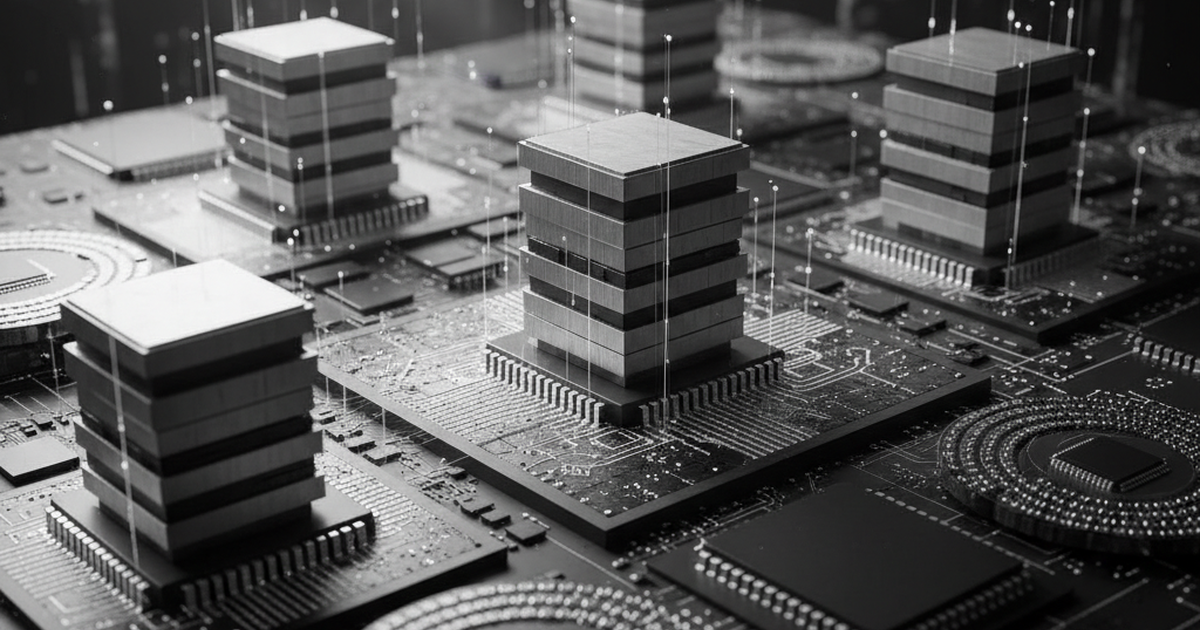
The market still treats AI compute as if the only scarce asset is the GPU. That was a useful framing in the first leg of the cycle, but it is becoming incomplete. Increasingly, the more important question is whether the accelerator can be shipped with enough high-bandwidth memory and advanced packaging capacity to make the platform usable at scale.
HBM is not just another component. It is one of the central performance determinants in modern AI systems. Training and inference workloads are memory hungry, model sizes continue to expand, and bandwidth matters because the economics of frontier compute break down quickly if the accelerator cannot be fed efficiently.
Why HBM matters now
Modern AI accelerators are no longer standalone chips in the old sense. They are integrated systems combining:
- leading-edge logic,
- advanced packaging,
- stacked memory,
- thermal design,
- and increasingly complex board-level integration.
That means supply can fail at multiple points. A company may have demand for accelerators, design wins, and willing customers — but if the memory stack or packaging line is constrained, revenue is still delayed.
This is why HBM matters so much. It sits at the intersection of performance and physical manufacturing difficulty. The suppliers capable of producing it at scale are few, qualification cycles are demanding, and the process complexity is high.
Scarcity is moving beyond the GPU die
The market is used to underwriting scarcity at the logic layer. NVIDIA designs the chip, TSMC fabricates it, and the product ships. In reality, the path is now much narrower:
- the logic die must be fabricated on advanced nodes,
- the memory stacks must be available in sufficient volume,
- the package has to integrate both reliably,
- the full module must then be tested, cooled, and delivered at hyperscale quality.
The weakest link in that chain can determine the actual revenue cadence.
That shifts more strategic importance toward:
- memory leaders with credible HBM capacity,
- advanced packaging ecosystems with room to expand,
- equipment suppliers benefiting from the need to scale packaging and memory output,
- and system-level companies whose execution depends on these layers arriving on time.
What investors often miss
The common mistake is to think of memory as lower-value support content attached to the “real” product. In AI, that framing breaks down. If memory bandwidth is central to throughput, then the memory layer starts to matter not just as content, but as a performance bottleneck and therefore as a source of bargaining power.
This matters for two reasons.
First, scarcity at the HBM layer can extend the duration of the broader AI capex cycle. If accelerator demand remains strong but memory and packaging are slow to scale, the revenue realisation of the full ecosystem gets staggered over a longer window.
Second, it broadens the field of investable beneficiaries. The AI trade is no longer only about whichever company designed the headline chip. It becomes about the smaller group of firms that can actually make the full product shippable.
The strategic implication
As the cycle matures, the market will likely pay more attention to which companies can secure memory supply, packaging slots, and co-optimised manufacturing partnerships. The winners are not always the companies with the loudest AI marketing. They are often the ones sitting on the scarce industrial capability.
That is why HBM matters so much in this phase. It is not a side note to the AI buildout. It is one of the places where the buildout becomes physically real.
If the first market question was “who gets the AI chip order?”, the next question is increasingly “who can deliver the complete memory-rich system in volume?” That is where some of the most important supply-chain leverage in AI may sit.
Related reading: start with our AI Supply Chain Thesis for the broader framework, then compare how memory scarcity interacts with networking economics and power constraints.