The Cooling Stack May Be the Hidden Bottleneck in AI
As rack densities climb and liquid cooling becomes standard, thermal management is shifting from a data-centre detail into a core dependency of the AI capex cycle.
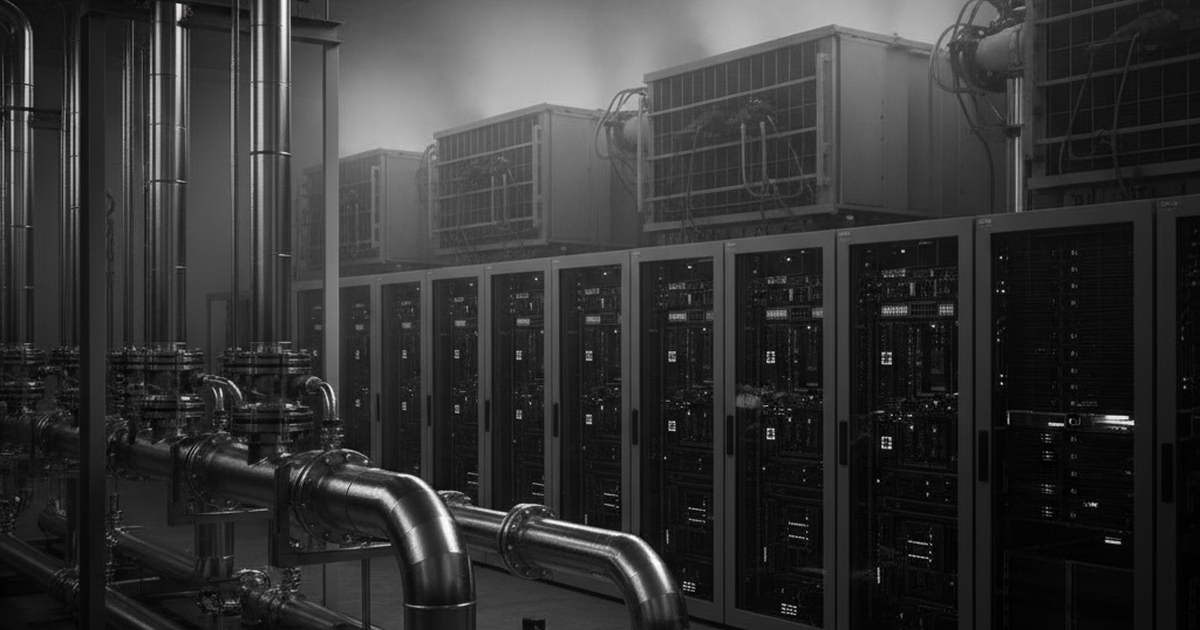
There is a persistent habit in AI investing: markets focus on the glamorous layer first and the enabling layer later. In the current cycle that means people obsess over accelerators and often underwrite cooling as generic support infrastructure.
That is a mistake.
As AI clusters become denser, cooling stops being a facilities footnote and becomes part of the core system design. The move from air-cooled environments toward liquid-based architectures changes how racks are built, how power is delivered, how reliability is maintained, and which suppliers gain strategic relevance.
Density changes everything
A traditional data-centre rack and a modern AI rack are not separated by degree. They are separated by category.
AI deployments are pushing toward dramatically higher power density, which means heat removal becomes one of the limiting factors on what can actually be installed and operated. Once that happens, thermal design is no longer optional optimisation. It becomes gating infrastructure.
That has direct consequences for:
- rack design,
- coolant distribution,
- heat-exchange systems,
- monitoring and reliability software,
- service and maintenance complexity,
- and the vendors trusted to integrate the stack.
Why this matters for the investment case
Cooling matters because it affects deployment speed, operating reliability, and the real cost of scaling AI infrastructure.
A hyperscaler may be willing to spend aggressively on accelerators, but those systems still have to be deployed into facilities that can support the thermal load. If the cooling architecture is not ready, the revenue cycle for the broader stack can slip.
That makes thermal infrastructure important for the same reason power infrastructure is important: it is part of what turns announced AI demand into physically usable capacity.
The market implication
As deployment complexity rises, the value tends to move toward companies that can deliver integrated solutions instead of disconnected components. In cooling, that can favour firms with stronger positions in:
- liquid cooling systems,
- integrated power-plus-thermal infrastructure,
- service and support,
- and the operational credibility to work directly with hyperscale customers.
The key point is that not all exposure is equal. The market will likely distinguish between generic exposure to data-centre infrastructure and specific leverage to next-generation AI rack density.
Cooling is part of the thesis, not an appendix
The AI buildout is often described as a compute race. A more accurate description is that it is a systems race. Compute, memory, networking, power, and cooling all have to scale together.
If one layer fails, the whole deployment slows.
That is why thermal infrastructure deserves more investor attention than it usually gets. It sits at the point where data-centre design, operational complexity, and AI hardware density collide. In that kind of environment, what looks like plumbing can become a source of economic leverage.
Cooling may never be the loudest part of the AI story. But it could become one of the clearest examples of how value accrues in an industrial buildout: not only to the most visible technology, but also to the infrastructure without which the technology cannot scale.
For a broader view of physical constraints, read our note on power. For the full system-level framework, start with the AI Supply Chain Thesis.